The Quantum Gun
Why Crypto Needs Quantum Computing (And Why We Invested in Quip Network)
By
Brian Breslow

Note to reader: This article covers both gate-model quantum computers (IBM, Google, IonQ) capable of running algorithms like Shor’s, and quantum annealers (D-Wave) specialized for optimization. They are different technologies with different strengths and timelines.
The Shield vs. the Gun. Would you rather own the quantum shield, or the quantum gun? That is the key question this research attempts to answer today. Everybody is scared of quantum breaking Bitcoin, but I'm an investor - I want to buy the bullet. Let's get into it.
There has been much talk lately on quantum computing and its aforementioned impact on bitcoin (and crypto) writ large. Much of this discourse centers around the risk quantum poses to decentralized ledgers, their encryption standards, and the pathways available to mitigate these attack vectors.
The quick refresh for anyone living under a rock this past year.
Quantum computers threaten to crack encryption standards that were previously considered impenetrable. The most cited mechanism is Shor's algorithm, which is theoretically capable of deciphering elliptic curve cryptography (ECC) keys [1]. For the uninitiated, ECC is the cryptographic standard most blockchains rely on for wallet security and public/private key pairing.
In practice, a cryptographically relevant quantum computer would need to crack 256-bit ECC to reverse engineer a private key from a known public key. Today, we're only at 6 bits [2]. We're not there yet. But the trajectory is what matters.

This is a log chart from Nic Carter’s Murmurations research – illustrates that not only are physical qubit counts growing, they are scaling exponentially (this is a log chart).
For most users, their bitcoin is not really at risk. There are even some at-home mitigants they can take to prevent this so-called “property theft.” They merely need to rotate their public key, which is good wallet hygiene practice anyway. Essentially just spawn a new wallet from a fresh seed phrase, send your bitcoin to this wallet, and as long as you don’t do a new transaction from it, your public key won't ever be exposed to the network, and your private key would never be derivable by quantum computers.
However, quantum computing still poses a unique risk to bitcoin given its history and the religion surrounding presumed lost keys… and of course, the holy grail: Satoshi’s keys.
Coins stuck in lost wallets obviously cannot be moved to fresh wallets, or even upgraded to quantum-resistant signature schemes should they become available. They act as a permanent public bounty, available to whoever uses quantum computing to crack those keys and claim the tokens. This is a titanic problem. To put the sizing in perspective, we are talking about 7M lost bitcoin (including Satoshi’s). This is a $500B+ bug bounty. [3]
Beyond market impact, movement of coins from Satoshi’s wallet could do irreparable harm to the culture of bitcoin. If those coins move, bitcoin’s symbol as immutable property rights and its status as an unseizable asset obviously comes into question. This will hurt the religion of OG bitcoiners and crypto natives to an immeasurable degree. This is a significant issue that appears unsolvable to me, and the bitcoin community will likely have to manage the fallout in real time.
I won’t go deep into the dialogue around potential solutions, as this has already been covered at length in other research (especially by Nic Carter… seriously go check out his murmurations blog if you haven’t yet. https://murmurationstwo.substack.com/), but the TL;DR is that it typically involves a method akin to property theft: a network upgrade rendering coins in old signature formats (P2PK vs modern Taproot addresses) unspendable, essentially burning Satoshi’s keys. This amounts to confiscation and will result in considerable tension in the bitcoin community.
I couldn’t write quantum research without mentioning the existential crisis which bitcoin faces. But alas, back to the main point of this article, which is the threat (and marriage!) of quantum computing with crypto, beyond just bitcoin.
Everyone is Selling The Shield
Broadly, the discussion around quantum computing and crypto typically revolves around post-quantum cryptography [4], encryption failure, and what we should be doing as an industry to protect ourselves from the inevitable and forthcoming quantum threat. I’ve seen extensive proposals and dialogues around the following “solutions”:
1. A new, quantum-resistant blockchain. A greenfield quantum-safe chain would have zero liquidity, zero network effects, zero applications, and zero reason to exist when the incumbents can simply upgrade.We don’t need another L1. The world already has Bitcoin, Ethereum, Solana, Hyperliquid, and a plethora of long-tail settlement layers and infrastructures with substantial economic value at risk.
2. Network upgrades to make existing blockchains quantum-resistant. Directionally correct. This approach actually solves the problem, i.e. shielding the majority of existing onchain economic value, wealth, smart contract logic, and property rights from quantum attacks. But I’m not sure this approach should look anything like a business. It’s better served as a community initiative or open-source public good. Most public blockchains with active development cycles are already accelerating their post-quantum roadmaps in a community driven way [5]. This is good because it actually solves the problem, but it's broadly uninvestable and not applicable to Bitcoin where the Core developer community is zealously opposed to hardforking the network, and would never adopt a network upgrade proposal from a VC-backed, rent-seeking project.
3. Quantum-secured multisigs or custody solutions. Maybe a UX improvement, but ultimately this already exists in the form of unrevealed public keys. If you send your crypto to a fresh wallet which has never done a transaction, this is already quantum-secured by default if the public key is never exposed, so there’s no way to algorithmically reverse engineer the private key.
Everyone is pitching various ways to protect oneself from quantum. We are being sold the shield.
I’m far more interested in how to use quantum technology. How to harness this science-fiction-like power to improve crypto. How to actually put it to work today and make our industry better, unlocking use cases previously thought impossible.
I’m not interested in the shield. I want the gun.

Quantum is "Not Too Early"
When I first met Colton and Rick (the founders of Quip Network), their vision of selling the gun rather than the shield instantly clicked.
Colton has had quite the interesting journey prior to his current role as CEO of Quip Network. Beginning his career as an actor (albeit a very mathematically inclined one, Colton holds a Masters in Engineering from Northwestern University, sold IP to Nike’s wearables division, and worked as an educator at Intel), Colton soon discovered crypto and in a dramatic turn evolved into a degen crypto native and experienced startup operator. He co-founded Gentlemen Labs, served as CEO and CTO at Hedgehog (YC S21), and held roles as Global Director and CMO at Acorns ($1.9B market cap). He has a demonstrable track record of being first to market in financial innovation. While his long detour through the worlds of finance and crypto have prevented him from publishing in quantum, he is pleased to return to his roots in applied mathematics pursuing a novel result in hardware embeddings and the characterization of graph invariants.
As CTO of Quip, Rick (who holds a doctorate from the University of Maryland Baltimore County) is a cryptographer and serial entrepreneur with a career that spans post quantum cryptographic systems engineering, verifiable elections, and privacy enhancing technology. He co-founded XX-Network, served as Chief Scientist at Lexumo, and was the departmental founder of Cyber at Charles Stark Draper Laboratories, work for which the cypherpunk site Cryptome had labeled him a cyber spy. He also has the distinction of being published in Nature for his data science work with vaccines, where I learned he had also done some early exploratory work on quantum computing and set up an HPC cluster for protein folding simulations.
Their perspective is that while true generalizable quantum computers are indeed still years away, there is already a tremendous amount of underutilized quantum compute available today, from quickly growing install bases of quantum processing units (QPUs) manufactured by a number of leading frontier quantum labs.
There are an estimated 100–200 quantum computers worldwide today [6]. Around 40 are commercially available QPUs, from about two dozen different manufacturers [7]. Many of these are annealers or limited logic-gate systems. Perhaps not the fully fault-tolerant machines that the media tends to fixate on, but real, operational quantum hardware doing useful work right now.
This led us down the rabbit hole of mapping the entire sector. I was honestly quite surprised to learn just how many quantum computing companies are already publicly traded, often at significant market capitalizations:
D-Wave: $QBTS, ~$10B market cap, $24.6M revenue in 2025 (180% growth YoY) [8]
IonQ: $IONQ, ~$17B market cap; ~110M revenue in 2025 (222% growth YoY) [9]
Quantinuum: Private, ~$10B valuation [10]
Rigetti: $RGTI, ~$8B market cap; ~$7M revenue in 2025 [11]
PsiQuantum: Private, ~$7B valuation [12]
SpinQ: Private, ~$118M+ valuation, ~$7M revenue (2025 estimate) [13]
Origin: Private,~$1B valuation (via recent minority share sale); ~$14M revenue (2024) (~growth into 2025, China’s first commercial quantum revenue) [14]

These aren’t just meme stocks either. Many of them are in the early stages of commercialization and generating real revenue. After having $24.6M in 2025 revenue, D-Wave is already on pace for a monster 2026, with $30M in just January bookings. [15]
Venture funding for quantum has also reached an inflection point. Venture capital roughly doubled year-over-year from ~$1.3–1.6B in 2023 to ~$2.0–2.6B in 2024, and then in just the first 9 months of 2025, total equity funding hit $3.77B, which is nearly 3x the full 2024 figure [16]. Government commitments also surged past $10B globally by April 2025, driven by Japan's $7.4B announcement and Spain's €808M investment [17].
Quantum is empirically “not too early.” The market exists. The hardware exists. The companies are public and generating revenue. The question is not whether quantum computing will matter, but rather who builds the infrastructure layer to make it accessible.
2025: The Year Quantum Got Real
From a technology progression standpoint, 2025 was a breakout year for quantum computing. The milestones came fast and from every direction:
March 2025: D-Wave’s Advantage2 quantum annealing computer demonstrated outperformance versus the world’s top classical supercomputers on a magnetic materials simulation problem. What took minutes on the Advantage2 would have taken an estimated one million years on a classical supercomputer. [18]
July 2025: Researchers at USC demonstrated exponential algorithmic speedup for a modified version of Simon’s problem using IBM quantum computers. The team ran circuits on noisy quantum hardware up to 126 qubits, showing that as the problem increased in size, the speedup scaled exponentially. [19]
July 2025: “Hyperspace”, an international project by Canada and Europe launched, aiming to create the first fully operational transatlantic quantum link. Over 120 years since the first transatlantic cable, this initiative would use satellites in space to beam quantum-encrypted messages via entanglement across continents. [20]
September 2025: Steve Tipconnic, an ASU graduate and quantum/bitcoin researcher, broke a 6-bit elliptic curve key using IBM’s 133-qubit quantum computer running Shor’s algorithm. [21]
October 2025: Google introduced a new quantum computational task measuring Out-of-Time-Order Correlators (OTOCs) using its Willow chip. This work demonstrated a verifiable quantum advantage and paved the way for solving real-world problems like Hamiltonian learning in Nuclear Magnetic Resonance. [22]
November 2025: IBM and Cisco announced a joint venture to design and ship a distributed network of quantum computers by 2030. IonQ and CERN launched the first citywide dedicated quantum network in Geneva (the Geneva Quantum Network), which will provide ultra-precise time signals. And a new world record was broken: a 50-qubit universal quantum computer was fully simulated for the first time on the Jupiter supercomputer in Germany, using 16,000 H200 GPUs. [23][24]
This growth curve has continued into 2026. On March 30th, 2026, two shocking announcements were made, both providing promising signals of quantum acceleration.
Google Research demonstrates a ~20x more efficient implementation of Shor's algorithm that could break ECDSA keys within minutes with ~500K physical qubits [25]
Secretive quantum startup Oratomic, in collaboration with Universities such as Caltech and UC Berkeley, show quantum computers can break crypto with just 10,000 reconfigurable atomic qubits. [26]
Progress is becoming exponential, driven largely by error correction improvements. In quantum computing, there is this error correction framework called “counting the nines”, where each additional “nine” of gate fidelity (99% → 99.9% → 99.99%) exponentially reduces error correction overhead [27]. Some systems now have 99.99%+ error correction rates, which means we can finally scale. Errors are being corrected faster than new errors are introduced, even when growing the size of physical qubit systems. We’ve crossed a critical inflection point where the growth of logical qubits is beginning to decouple from the noise floor of physical hardware.
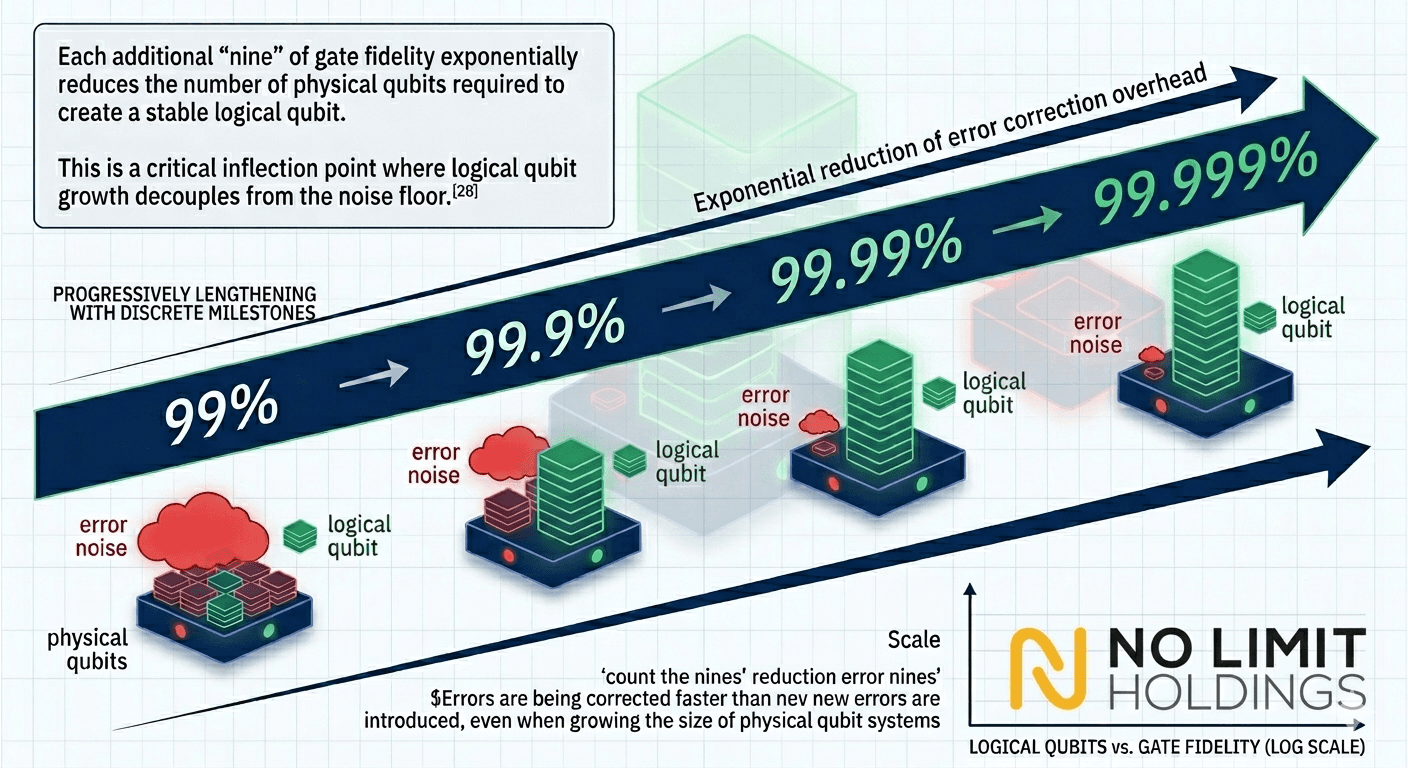
Counting the "nines"
Quantum Annealing: The Quiet Revolution
Most people, when they think of quantum computing, picture the fully universal, fault-tolerant quantum machine that can run any algorithm on any problem. That’s the endgame. But the quantum systems that are commercially relevant today are a different breed entirely.
Enter quantum annealing.
Quantum annealers are specialized quantum computers optimized for a specific class of problems: combinatorial optimization. Think of it as finding the lowest energy state in a complex system, basically the “best” solution across millions or billions of possible configurations.

Image from ’60 Minutes: The Quantum Computer Revolution’ — CBS News
Problems like portfolio optimization, logistics routing, drug discovery, materials science, and critically for our purposes, many blockchain-native computation challenges.
D-Wave is the current leader in this category, with its 4,400-qubit Advantage2 system. Unlike gate-based quantum computers (IBM, Google), which try to be general-purpose but are still throttled by error rates and limited qubit counts, annealers are purpose-built machines that are already outperforming classical hardware on specific tasks today.

D-wave Advantage2 quantum computer
Some real-world implementations of D-Wave’s quantum annealing system include:
In 2019, Volkswagen and D-wave collaborated to compute real-time traffic routing for buses in Lisbon. D-wave systems solved 1,200+ routing problems across several days [28]. This was live deployment, not just lab simulations.
Recent work with AT&T to optimize fleet operation and network outage rerouting. D-wave’s quantum solution provided order of magnitude improvement over classical approaches. [29]
In early 2026, D-wave worked with BASF, a multinational chemical producer, to develop a POC for bottling plant optimization and scheduling. Via D-Wave Advantage2 machines, the project reduced scheduling time from 10 hours to just seconds. [30]
Energy efficiency wise, the performance data of QPUs vs. GPUs are striking. In head-to-head benchmarks, D-Wave’s Advantage2 system uses just 12.5 watts and solves optimization problems in 3.5 seconds with 100% best-solution optimality. Compare that to 80 NVIDIA H100 GPUs: 1,334 watts, 78 seconds per solution, and only 99.46% optimality — with only 8% of solutions arriving faster than the quantum system. Scale up to 1,024 H100s and you get faster time-to-solution, but at 3,868 watts, 309x the energy cost, and still not matching quantum on solution quality.


Real demos of D-wave Advantage2 quantum annealing machine beating GPU and CPU systems at mining certain blockchain networks
![QPUs require substantial less electricity and power to run equivalent operations as GPUs [31]](https://framerusercontent.com/images/6fzSjJMRT0qA9C2d3vgn09r6I.png?width=1482&height=1312)
QPUs require substantial less electricity and power to run equivalent operations as GPUs [31]
This is not a theoretical comparison. This is production hardware, today, outperforming the most powerful classical GPU clusters in the world on a meaningful class of problems. Maybe quantum annealers can’t crack ECC cryptography and steal private keys and lost bitcoin, but they offer a significant speed up for factoring, optimization, and blockchain mining at a fraction of the energy cost of GPUs.
The annealing approach is also why these companies have been able to commercialize ahead of the fully universal quantum crowd. You don’t need to solve the full error correction problem to make an annealer useful. You just need a problem that maps well to the hardware’s native physics, and it turns out, quite a lot of interesting problems in crypto do.

AT&T exploring D-Wave quantum annealers to solve network outage optimization problems
Why QPU Companies Need QUIP
So quantum hardware exists. It’s commercializing. It outperforms classical computers on specific tasks. Great. What is still holding this industry back?
The simple fact is the quantum computing industry has four structural problems that hardware alone cannot solve. It just so happens these are exactly the problems that Quip Network is built to address.
1. No verifiable quantum supremacy. This might be the most underappreciated barrier. QPU manufacturers can publish benchmark results all day long, but enterprises remain skeptical because there’s no independent, public, adversarial system continuously testing quantum versus classical performance. Quip solves this through its Quantum Proof of Work (QPoW) consensus mechanism [32]: if quantum miners consistently win more blocks than classical miners, and this is publicly verifiable on-chain, you can’t argue with that. It’s the most credible quantum supremacy demonstration possible… an economic competition where real money is at stake.
2. Costly low utilization rates. This is an even bigger problem for QPUs than it is for GPUs, because many types of quantum computers need to be kept at near absolute zero temperature regardless of whether they’re being used. The cooling infrastructure runs 24/7. An idle QPU is an enormous cost center with zero revenue offset [33]. Manufacturers are desperate for any use case that can absorb their idle compute, and Quip provides exactly that distribution channel. By routing crypto-native workloads (and eventually broader commercial queries) to underutilized QPUs, Quip becomes the go-to marketplace for quantum capacity.
3. No self-serve APIs or customer discoverability. Today, accessing a quantum computer requires a lengthy consulting engagement. You talk to a sales team, negotiate a contract, do weeks of scoping, and eventually get credentialed onto a proprietary cloud portal. There is no equivalent of “pip install quantum.” This kills customer discoverability and creates massive churn. Why is this? Well today’s early QPUs have a lot in common with ASICs. They are programmed to do one particular type of workload effectively, but they are not generalizable. Unlike AI, where the Transformer emerged as the dominant paradigm, quantum computing has six competing qubit modalities and hasn't yet converged on a single winner [34]. Different QPUs from different manufacturers excel in slightly different tasks. For someone running a quantum job, they need to be sure they are matching their job with the correct hardware. For most businesses without phd level quantum knowledge (read: basically all of them), this is a significant challenge. QPU companies don’t offer open APIs because they’re worried about incorrect job matching causing churn and unsatisfactory results. Quip’s orchestration layer and smart-routing engine can enable public APIs for the first time, dramatically lowering the barrier to trying quantum computing.
4. No open-source community. Quantum talent and algorithms remain almost entirely siloed within corporate R&D labs. There is no equivalent of Hugging Face for quantum. No open model zoo. No permissionless marketplace for quantum algorithms. Crypto’s longstanding culture of open-source development and token incentivized contributions serves as the perfect accelerant to idea sharing and development within this space. This is how you bootstrap an open-source quantum ecosystem.
These aren’t nice-to-have features. These are existential gaps in the quantum computing value chain that, if left unfilled, will continue to throttle the industry’s growth trajectory regardless of how good the hardware gets. Quip is building the connective tissue and software layer that makes quantum hardware useful.
What Quantum Can Do for Crypto Today
Here’s where the thesis gets really interesting. Everyone is asking how to protect crypto from quantum. Almost nobody is asking how quantum can make crypto better. But the answer is hiding in plain sight, because several of crypto’s biggest revenue centers are essentially optimization problems, exactly the kind of thing quantum annealers already outperform classical hardware on.
Verifiable Random Functions (VRF). On-chain randomness is foundational to DeFi, gaming, trading, and gambling/onchain casino-type applications. For example, think about the growing popularity of the trading card game (TCG) platform Collector Crypt ($CARDS), and its “gacha” mechanism. You rip open card packs, keep what you like, sell what you don’t, and use the proceeds to keep opening new decks. It is very similar to hitting the “mystery box” to upgrade your weapon in the video game Call of Duty Zombies. Collector Crypt has a cumulative marketplace volume of nearly $500M and generates annualized fees of ~$30M USD [35]. This entire protocol is built on top of weak randomness guarantees (in fact all cards are pre-minted, and manually assigned probabilistic odds of being drawn). Quantum systems can generate truly random outputs vs pseudorandom outputs from classical computers. Quantum enables fundamental randomness at the physics level. This is a massive improvement over current VRF implementations from oracle protocols such as Chainlink or Pyth, which rely on computational assumptions that may not hold as adversaries get more powerful. Chainlink in particular generates ~$60M in annualized fees [36], and while mostly thought of as an oracle and price feed infrastructure, a substantial portion of their business is dedicated to providing random number generation (RNG) to leading onchain applications.

Trying my luck with the newest onchain quantum casino
Solver Networks and MEV. The solver and MEV economy on Ethereum, Solana, and other chains is a multi-billion dollar sector [37]. Solvers compete to find optimal transaction orderings, arbitrage routes, and execution paths. These are combinatorial optimization problems (i.e. the exact domain where quantum annealers shine). A solver backed by quantum computers could find better solutions faster than any classical competitor. MEV extraction, intent matching, and auction mechanisms all stand to benefit from quantum-accelerated optimization.
Hybrid mining pools. Mining pools augmented with QPUs could theoretically mine more efficiently than purely ASIC-based (classical) pools for certain problem types. While Quantum Annealers cannot run Grover's algorithm [38] (a quantum search algorithm commonly cited as a method to speed up sha256 hashing), there is current work being done to theoretically restate the problem of finding a pre-image of a hash as a problem compatible with annealers [39]. We remain very excited by the potential for quantum annealers to disrupt the traditional ASIC based mining model.
Zero-knowledge proofs and quantum derivatives. This one is admittedly more speculative, but ZK proof generation involves heavy mathematical computation that could see speedups from quantum assistance. ZK proof systems (like SNARKs and STARKs) rely on linear algebra-like workloads (such as elliptic curve operations and multi-scalar multiplication), and in theory quantum algorithms quantum algorithms can accelerate some classes of these problems. Hardware acceleration stacks from companies like Ingonyama and Irreducible are already highly adopted in this space, so it’s not a far cry to say quantum speedups will be tested here in the future as well.
The crypto industry already has massive, proven revenue centers that map directly to quantum computing’s current capabilities. QPU companies just need a partner to help them plug into these use cases and do business development at scale. That partner is Quip.
Introducing Quip Network
Quip Network is the world’s first decentralized quantum computing marketplace. Think of it as “Coreweave for quantum” i.e. a unified orchestration layer that connects quantum hardware providers, algorithm designers, classical validators, and end users through a token-based ecosystem.
To put the analogy in perspective, Coreweave is a specialized GPU cloud, specifically tailored for ai-native use-cases. Instead of running generic cloud compute, it specializes in GPU clusters used for training and running ai models. This ai-optimized infrastructure software is highly valuable, as evidenced by Coreweave’s $40B market capitalization. [40]
Quip is essentially doing the same thing for Quantum. They are not merely reselling QPU compute time, but rather offering a software layer and network which enables the widespread usage and orchestration of complex quantum workloads across their decentralized cloud.
Specifically, the platform’s core architecture is built around several key innovations:
Cross-QPU Orchestration. Quip can route optimization problems to D-Wave’s annealing systems and gate-based problems to IBM or Google hardware. This is the first platform that abstracts away the underlying quantum architecture and gives users a single interface to access the best hardware for their specific problem type.
Quantum Proof of Work (QPoW). This is Quip’s breakthrough innovation, developed in direct collaboration with major publicly traded QPU manufacturers. The flow works like this: quantum miners receive pre-formatted computational problems from users. Problems are solved using quantum hardware optimized for specific algorithm types. Results are cryptographically proven and submitted to classical validators. Validators verify quantum outputs using classical computation where possible. Successful miners earn QUIP tokens proportional to computational complexity.
Quip generates value through multiple revenue streams tied to network usage and ecosystem growth:
Compute Fees: Users purchase QUIP tokens to access quantum compute, with pricing tied to problem complexity and hardware requirements. QUIP is valuable because holding it guarantees access to scarce quantum compute, on the most desirable quantum computers available at any given point in time. QUIP is the most straightforward way to trade your undesirable idle compute now, on either classical or quantum hardware, for the most desirable compute in the future. (once quantum advantage is reached, everyone wants this compute… QUIP is a call option on the future)
Network Take Rate: A platform fee on all transactions, with a portion used to fund deep liquidity in permanent liquidity pools across chains, driving price stability and token scarcity.
Professional Services: Enterprise consulting for quantum application development and deployment.
Licensing Revenue: AGPL licensing for commercial use of the Quip technology stack. Think of it as “gcc or CUDA for quantum.”
The flywheel is intuitive: more quantum hardware providers join the network, which attracts more algorithm designers, which attracts more end users, which attracts more validators, which makes the network more valuable, which attracts more hardware providers. It’s the classic marketplace dynamic, applied to quantum compute.
The Quantum Spot Market
What Quip is doing for quantum compute has a direct parallel in what’s happening right now in the classical GPU compute market. Compute is commoditizing, and this previously “dark market” is being lit up for the first time, making price discovery and financialization possible.
Compute is a $250B+ market. But it’s still a “dark market”, meaning pricing is fragmented and opaque, trading is bilateral and over-the-counter (OTC), idle supply isn’t getting matched with demand, and there’s no real-time price discovery mechanism. There is no widely accepted “benchmark” price of compute, and not even a general consensus around what the basic unit of compute should be. Right now, if you want to trade spot GPU prices, or compute futures, it’s the equivalent of calling a taxi (vs. an algorithmic marketplace like Uber which aggregates a network of drivers and sets prices dynamically in real time based off a supply-demand function). A handful of companies (Yotta, Ornn, Pluto Trade, Silicon Data, Prime Intellect, among others) are actively trying to change this by building the infrastructure for a lit compute market: benchmarks, indices, orderbooks, and eventually derivatives.
Looking even further back, an analogy to energy markets is instructive. Electricity was once local, illiquid, and opaque. Then Enron (who was unironically quite transformational to the energy industry before the notorious fraud case) standardized contracts around time, location, and capacity (creating the benchmark price reference with EnronOnline) — owned infrastructure, was capable of physical delivery, and built financial derivatives on top. At their peak, Enron was handling ~35% of all energy hedging flow [41]. The same evolution is beginning to happen for GPU compute.
Now apply this framework to quantum. If classical compute is just now getting its commodity infrastructure, quantum is years behind even that. Everything in the quantum computing market today is reserved instances and bespoke consulting engagements. There is no spot price for quantum compute. No benchmark index. No futures curve. No way to hedge.
Quip’s token is effectively the first floating spot price for quantum compute. By denominating quantum access in QUIP tokens, the network creates real-time price discovery for quantum workloads, which something that simply does not exist anywhere else in the market. And just as classical compute is evolving from bespoke procurement to standardized, tradable commodity markets, quantum will follow the same path. Quip is positioned to be the infrastructure layer for that transition.
Market Timing
Quip is launching at what we believe is the precise inflection point where quantum computing transitions from research to commercial application. Industry leaders such as Microsoft, Google, IBM, Nvidia have updated their timelines from 10–20 years to 2–5 years for broad quantum advantage [42]. The “Quantum Doomsday Clock” (the projected timeline for cryptographically relevant quantum computers) points to approximately 2028, creating urgency for post-quantum preparation [43].
Enterprise adoption is accelerating. Goldman Sachs, Mastercard, and BMW are actively developing quantum-ready applications. D-Wave recently announced a $10M, two-year enterprise QCaaS (Quantum Computing as a Service) agreement with a Fortune 100 company [44].

AT&T is running quantum network pilots. This is not speculative… the enterprise pipeline is being built.
And critically for Quip: there's a first-mover advantage to be captured. No one else is building the decentralized orchestration layer for quantum. By the time the market fully wakes up to the opportunity, Quip will already have the network effects, the hardware partnerships, and the token economy in place.
Why We Invested
The thesis comes down to a few key convictions:
Quantum computing is commercially real today, and the gap between what the hardware can do and what the market actually uses it for is enormous. That gap is Quip’s opportunity.
Crypto is the ideal first market for quantum, because its biggest revenue centers (optimization, randomness, proof generation) map directly to quantum’s current capabilities. Quip is the bridge between these two worlds.
First-mover advantage matters here. Network effects in marketplace businesses are durable. The first platform to aggregate meaningful quantum compute supply and build a user base will be extremely difficult to displace.
Although it might feel like investing in quantum today is the equivalent of investing in GPUs when the mainframe came out, you have to believe the time it takes to go from QPU to quantum supremacy will be far shorter than from mainframe to AI. The cycle is compressing.
Right now we are approaching the “CUDA moment” for quantum. When Nvidia launched Compute Unified Device Architecture (CUDA) in 2007, it turned GPUs from “graphics-only chips” into general-purpose parallel compute machines. The key demos from the CUDA unveiling showed speedups of 10x - 100x vs CPU peers [45]. GPU supremacy became undeniable in 2012 during the ImageNet Large Scale Visual Recognition Challenge. The most famous project from this competition, AlexNet, built by Geoffrey Hinton’s team (Hinton is a British-Canadian computer scientist widely known as “the Godfather of AI”), used GPUs to significantly outperform previous image recognition error rates with 10x faster training [46].

AlexNet
It was this CUDA architecture, more so than Nvidia’s technology, that provided them their long-term competitive moat. This is what ultimately led to the rise of GPUs for AI.
By the time AlexNet and CUDA were popularized, all of the existing infrastructure players were already positioned. We feel that quantum is on the cusp of its own “AlexNet” or “CUDA” moment, and the window to invest is now.

The CUDA architecture
For us, Quip is the spark that lit the quantum fuse. We are excited to support Quip on their journey, and now obsessed with finding the next generation of quantum founders. If you are building at this intersection of quantum and crypto, we’d love to chat. Some early ideas we have include (not prescriptive or comprehensive):
Quantum simulation marketplaces, similar to products being developed by Quantinuum or PsiQuantum. These tokenized quantum markets could power things like pharma/material discovery DAOs, decentralized quantum research, and more.
Quantum-powered financial modeling for accelerating monte carlo simulations, portfolio optimization, ai trading, onchain options pricing, risk engines for more efficient lending, etc. Banks like JP Morgan and Goldman Sachs are already deep in the weeds researching this topic.
Quantum native identity solutions, i.e. a DID that is quantum resistant
Quantum Sensing DePIN networks: Could power sensor infrastructure for gravity anomalies, magnetic fields, time synchronization, climate/earth observation DAOs, decentralized GPS, Edge networks for humanoid robotics.
Thanks / acknowledgements / disclosures to be added below
Huge thanks to Colton and Rick from the Quip team for their feedback and guidance putting together this research piece. Their unique insights helped make this paper what it is today.
Also shoutout to Tulip King, my close friend and confidant, whose advice and feedback greatly influenced the tone and style of this paper.
Disclaimer: The views expressed herein are solely those of the author and are provided for informational purposes only. They do not constitute investment, legal, tax, or other professional advice, and should not be relied upon as the basis for any investment decision. References to specific companies, protocols, tokens, or sectors are illustrative only and do not constitute a recommendation or solicitation to buy or sell any security, token, or other asset. The author is an investor at No Limit Holdings, a venture capital firm that invests in blockchain and digital asset-related businesses, and No Limit Holdings and/or its affiliates may hold positions in, or have other economic interests in, certain companies, protocols, tokens, or sectors discussed herein.
Message Ahead, “Shor’s Algorithm: Breaking RSA and ECC Encryption – Part 1,” Message Ahead, December 29, 2024, accessed March 2, 2026, https://p51lee.github.io/quantum-computing/shor/.
Steve Tippeconnic (@stevetipp), “From 16,384 shots, the quantum interference reveals a diagonal ridge in the 64 x 64 QFT outcome space. The quantum circuit, over 340,000 layers ...,” X, September 15, 2025, https://x.com/stevetipp/status/1962935033414746420.
To Freeze or Not to Freeze: Satoshi and the USD 440 Billion in Bitcoin Threatened by Quantum Computing, CoinDesk, February 22, 2026, https://www.coindesk.com/business/2026/02/22/to-freeze-or-not-to-freeze-satoshi-and-the-usd440-billion-in-bitcoin-threatened-by-quantum-computing.
Post-Quantum Cryptography (PQC), NIST Computer Security Resource Center, updated December 11, 2025, accessed March 2, 2026, https://csrc.nist.gov/projects/post-quantum-cryptography.
Vitalik Buterin Unveils Ethereum Roadmap to Counter Quantum Computing Threat, CoinDesk, February 26, 2026, https://www.coindesk.com/tech/2026/02/26/vitalik-buterin-unveils-ethereum-roadmap-to-counter-quantum-computing-threat.
How Many Quantum Computers Are There in 2025? SpinQuanta, March 12, 2025, https://www.spinquanta.com/news-detail/how-many-quantum-computers-are-there.
Beth Stackpole, “New MIT Report Captures State of Quantum Computing,” MIT Sloan School of Management Ideas Made to Matter, August 19, 2025, accessed March 2, 2026, https://mitsloan.mit.edu/ideas-made-to-matter/new-mit-report-captures-state-quantum-computing.
D-Wave Quantum Inc. (QBTS) Stock Price, News, Quote & History, Yahoo Finance, accessed March 2, 2026, https://finance.yahoo.com/quote/QBTS/
IonQ Inc. (IONQ) Stock Price, News, Quote & History, Yahoo Finance, accessed March 2, 2026, https://finance.yahoo.com/quote/IONQ/.
Dan Milmo, “Quantum computing firm reaches $10bn valuation as investor interest builds,” The Guardian, September 4, 2025, https://www.theguardian.com/technology/2025/sep/04/quantum-computing-firm-reaches-10bn-valuation-as-investor-interest-builds.
Rigetti Computing, Inc. (RGTI) Stock Price, News, Quote & History, Yahoo Finance, accessed March 2, 2026, https://finance.yahoo.com/quote/RGTI/.
Quantum computing startup PsiQuantum valued at $7 billion in latest funding round, teams up with Nvidia, Reuters, September 10, 2025, https://www.reuters.com/business/psiquantum-valued-7-billion-latest-funding-round-teams-up-with-nvidia-2025-09-10/.
Quantum Computing Valuation: Navigating the Hype and the Future, SpinQuanta, accessed March 2, 2026, https://www.spinquanta.com/news-detail/quantum-computing-valuation-navigating-the-hype-and-the-future.
Valued at 6.9 Billion Yuan! China’s First Commercial Quantum Computing Company Advances Toward A-Share Listing, Futunn, September 16, 2025, https://news.futunn.com/en/post/62170560/valued-at-6-9-billion-yuan-china-s-first-commercial.
D-Wave Quantum’s Dual Platform Shift and the Question of the Company’s Future, Yahoo Finance, February 27, 2026, https://finance.yahoo.com/news/d-wave-quantum-dual-platform-021043692.html.
"Superpositioned: The Quantum Decade Ahead,” Superpositioned, accessed March 3, 2026, https://www.superpositioned.co/.
“Superpositioned: The Quantum Decade Ahead,” Superpositioned, accessed March 3, 2026, https://www.superpositioned.co/.
Beyond Classical: D-Wave First to Demonstrate Quantum Supremacy on Useful, Real-World Problem, D-Wave Quantum press release, March 3, 2025, https://www.dwavequantum.com/company/newsroom/press-release/beyond-classical-d-wave-first-to-demonstrate-quantum-supremacy-on-useful-real-world-problem/.
Jennifer Janechek, “Researchers at USC Demonstrate Exponential Quantum Scaling Speedup,” IBM Quantum Blog, July 16, 2025, https://www.ibm.com/quantum/blog/simons-problem-quantum-speedup.
Matt Swayne, “Scientists to Beam Quantum Data From Europe to Canada to Outsmart Tomorrow’s Hackers,” The Quantum Insider, July 10, 2025, https://thequantuminsider.com/2025/07/10/scientists-to-beam-quantum-data-from-europe-to-canada-to-outsmart-tomorrows-hackers/.
Steve Tippeconnic (@stevetipp), “From 16,384 shots, the quantum interference reveals a diagonal ridge in the 64 x 64 QFT outcome space. The quantum circuit, over 340,000 layers ...,” X, September 15, 2025, https://x.com/stevetipp/status/1962935033414746420.
Xiao Mi and Kostyantyn Kechedzhi, “A Verifiable Quantum Advantage,” Google Research Blog, October 22, 2025, https://research.google/blog/a-verifiable-quantum-advantage.
IBM and Cisco Announce Plans to Build a Network of Large-Scale, Fault-Tolerant Quantum Computers, IBM Newsroom, November 20, 2025, https://newsroom.ibm.com/2025-11-20-ibm-and-cisco-announce-plans-to-build-a-network-of-large-scale%2C-fault-tolerant-quantum-computers.
IonQ and Swiss Consortium Launch First Citywide Dedicated Quantum Network in Geneva, IonQ press release, November 5, 2025, https://www.ionq.com/news/ionq-and-swiss-consortium-launch-first-citywide-dedicated-quantum-network.
Ryan Babbush et al., “Securing Elliptic Curve Cryptocurrencies against Quantum Vulnerabilities: Resource Estimates and Mitigations,” Google Quantum AI, March 30, 2026, https://quantumai.google/static/site-assets/downloads/cryptocurrency-whitepaper.pdf.
Madelyn Cain et al., “Shor’s Algorithm Is Possible with as Few as 10,000 Reconfigurable Atomic Qubits,” arXiv, March 30, 2026, arXiv:2603.28627, https://arxiv.org/abs/2603.28627.
“Superpositioned: The Quantum Decade Ahead,” Superpositioned, accessed March 3, 2026, https://www.superpositioned.co/.
Volkswagen Optimizes Traffic Flow with Quantum Computers, Volkswagen AG media information no. 373/2019, October 31, 2019, https://www.volkswagen-newsroom.com/.
D-Wave Industries Data Sheet, D-Wave Quantum, February 27, 2026, https://www.dwavequantum.com/media/5tahhz1d/dwave_industries_data_sheet_2_27_2026_v2.pdf
D-Wave Industries Data Sheet, D-Wave Quantum, February 27, 2026, https://www.dwavequantum.com/media/5tahhz1d/dwave_industries_data_sheet_2_27_2026_v2.pdf
Andrew D. King et al., “Beyond-Classical Computation in Quantum Simulation,” Science 388, no. 6743 (April 11, 2025): 199–204, https://doi.org/10.1126/science.ado6285.
Mohammad H. Amin et al., “Blockchain with Proof of Quantum Work,” arXiv, March 18, 2025, revised February 9, 2026, arXiv:2503.14462, https://arxiv.org/abs/2503.14462.
Researchers See Path to Quantum Computing at Room Temperature, Lab Manager, May 4, 2020, https://www.labmanager.com/researchers-see-path-to-quantum-computing-at-room-temperature-22581.
“Superpositioned: The Quantum Decade Ahead,” Superpositioned, accessed March 3, 2026, https://www.superpositioned.co/.
Jacktheguy, “Collectorcrypt,” Dune Analytics, accessed March 3, 2026, https://dune.com/jacktheguy/collectorcrypt.
“Chainlink,” DefiLlama, accessed March 3, 2026, https://defillama.com/protocol/chainlink.
Sumanth Neppalli, “The Inevitability of MEV: Inside Crypto’s Hidden Auction Houses,” Decentralised.co, May 13, 2025, https://www.decentralised.co/p/the-inevitability-of-mev.
“Grover’s Algorithm,” Wikipedia, last modified January 2026, https://en.wikipedia.org/wiki/Grover%27s_algorithm.
Yufei Ding et al., “Systematic Tensorization for High-Performance Neural Network Inference,” IEEE Xplore, 2025, https://ieeexplore.ieee.org/document/10817897.
CoreWeave, Inc. (CRWV) Stock Price, News, Quote & History, Yahoo Finance, accessed March 3, 2026, https://finance.yahoo.com/quote/CRWV/.
“Enron – One of the Biggest Stock Market Scams of All Time,” EWM Interactive, August 4, 2018, https://ewminteractive.com/enron-scandal-biggest-stock-market-scams.
John Koetsier, “Quantum Computing: IBM Says ‘Verified Quantum Advantage’ by 2026, Fault-Tolerant Quantum Computing by 2029,” Forbes, November 12, 2025, https://www.forbes.com/sites/johnkoetsier/2025/11/12/ibm-verified-quantum-advantage-by-2026-fault-tolerant-quantum-computing-by-2029/.
“Explanation,” Quantum Doom Clock, accessed March 3, 2026, https://quantumdoomclock.com/explanation.
D-Wave Announces $10 Million, Two-Year Enterprise QCaaS Agreement with Fortune 100 Company, D-Wave Quantum press release, January 27, 2026, https://www.dwavequantum.com/company/newsroom/press-release/d-wave-announces-10-million-two-year-enterprise-qcaas-agreement-with-fortune-100-company/.
Mufakir Qamar Ansari and Mudabir Qamar Ansari, “Accelerating Matrix Multiplication: A Performance Comparison Between Multi-Core CPU and GPU,” arXiv, July 26, 2025, arXiv:2507.19723v1, https://arxiv.org/abs/2507.19723.
Siddhesh Bangar, “AlexNet Architecture Explained,” Medium, June 24, 2022, https://medium.com/@siddheshb008/alexnet-architecture-explained-b6240c528bd5.
© 2024 No Limit Holdings. All rights reserved.